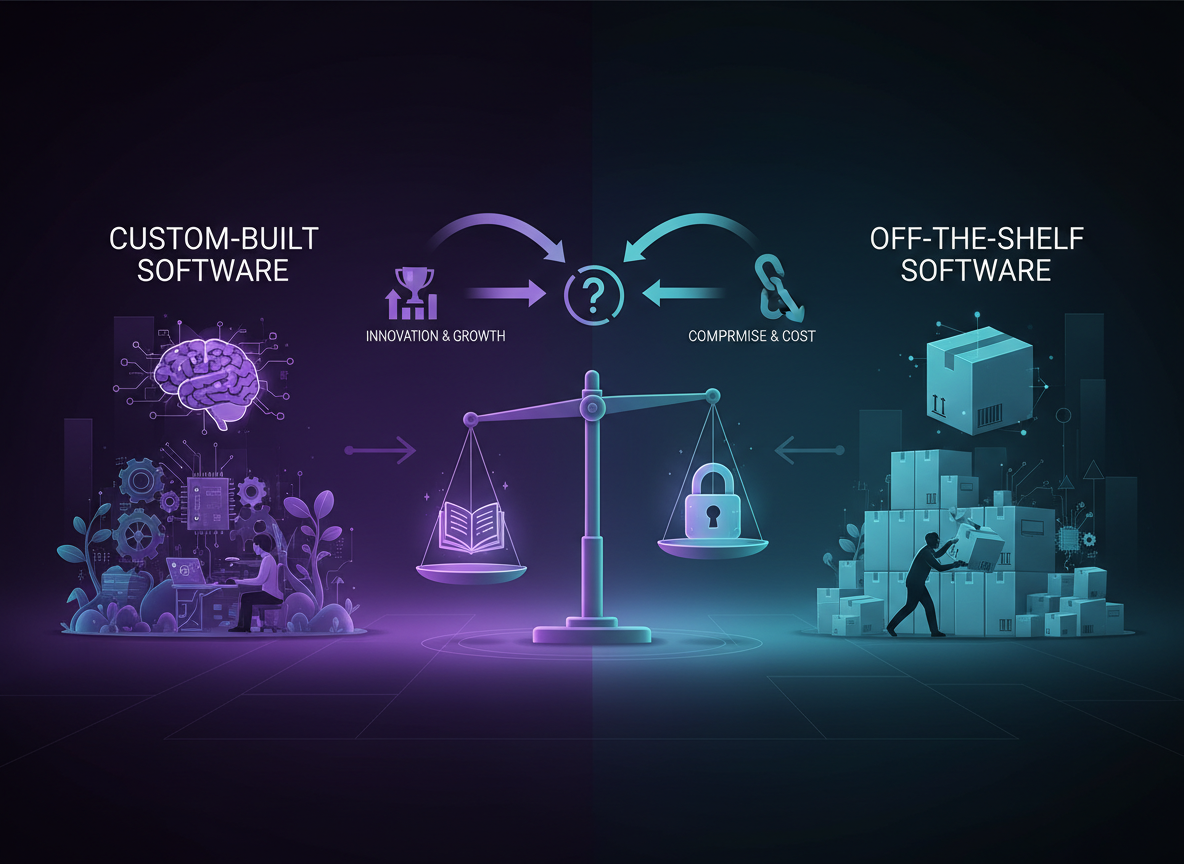
Every growing business hits the same crossroads: your current tools aren't cutting it anymore, and you need to decide whether to buy an off-the-shelf software solution or invest in something built specifically for you. It's one of the most consequential technology decisions a small business can make — and getting it wrong is expensive either way. If you're already leaning toward custom, see our custom software development service for how we approach it.
This guide gives you a clear, honest framework for making the build-vs-buy decision. We'll cover the real costs, the hidden trade-offs, and the specific scenarios where each option wins. For more on why custom software matters, read Why Small Businesses Need Custom Software in 2025.
What Is Off-the-Shelf Software?
Off-the-shelf software (also called commercial off-the-shelf or COTS) is pre-built software designed to serve a broad range of users. Think QuickBooks for accounting, HubSpot for CRM, Shopify for e-commerce, or Zendesk for customer support. These products are built by software companies, sold to thousands of customers, and updated on a vendor-controlled schedule.
The appeal is obvious: you can sign up today and be running tomorrow. No development time, no upfront build cost, and someone else handles maintenance and updates.
What Is Custom Software?
Custom software is built specifically for your business, your workflows, and your users. A development team (in-house or outsourced) designs, builds, and deploys software that does exactly what you need — nothing more, nothing less.
Custom software can range from a simple internal tool (a custom inventory tracker) to a full SaaS platform (a ticketing system for theatre venues). The defining characteristic is that it's built around your requirements, not a vendor's assumptions about what most businesses need. See our cost breakdown guide for what small businesses actually pay.
Side-by-Side Comparison
| Factor | Off-the-Shelf | Custom Software |
|---|---|---|
| Upfront Cost | Low ($0–$500 setup) | High ($5,000–$150,000+) |
| Ongoing Cost | $50–$500+/mo (per user fees) | Hosting + maintenance only |
| Time to Launch | Days to weeks | Weeks to months |
| Customization | Limited to vendor options | Unlimited — built your way |
| Data Ownership | Vendor-hosted (limited control) | Your servers, your data |
| Scalability | Vendor-controlled limits | Scale exactly as needed |
| Integrations | Pre-built (vendor's list) | Custom — any API you need |
| Vendor Lock-in | High — hard to migrate | None — you own the code |
| Maintenance | Vendor handles it | You or your developer |
| Competitive Edge | Same tools as competitors | Unique advantage |
The Hidden Costs of Off-the-Shelf Software
The monthly subscription fee is just the beginning. As your business grows, off-the-shelf software costs compound in ways that aren't obvious at signup:
- ⚠Per-user pricing: A $25/user/month tool costs $750/month for 30 employees — $9,000/year.
- ⚠Feature tiers: The features you actually need are often in the $100+/month tier, not the advertised entry price.
- ⚠Integration fees: Connecting your CRM to your email tool to your billing system often requires paid middleware like Zapier ($50–$500/mo).
- ⚠Migration costs: When you outgrow a tool, migrating years of data to a new platform is expensive and painful.
When Off-the-Shelf Is the Right Choice
Off-the-shelf software wins in these scenarios:
- ✓You need to move fast: If you need a solution running in days, not months, off-the-shelf is the only realistic option.
- ✓Your needs are standard: If your workflow matches what thousands of other businesses do, a pre-built tool probably covers 95% of your needs.
- ✓Budget is very tight: Early-stage businesses with limited capital should start with off-the-shelf tools and build custom later when revenue supports it.
- ✓The market is mature: For accounting, email marketing, and basic CRM, off-the-shelf tools are so good that custom rarely makes sense.
- ✓You need vendor support: Off-the-shelf tools come with support teams, documentation, and communities. Custom software support depends entirely on your developer.
When Custom Software Is the Right Choice
Custom software becomes the better investment when:
- →Your process is unique: If your workflow doesn't fit any existing tool — or you're constantly working around limitations — custom is worth the investment.
- →You're paying too much in subscriptions: If you're spending $2,000+/month on SaaS tools, custom software often pays for itself within 12–18 months.
- →You need competitive differentiation: Proprietary software is a moat. Your competitors can't copy a tool that only you have.
- →You need deep integrations: When you need your systems to talk to each other in specific ways, custom integration beats duct-taping SaaS tools together.
- →Data ownership is critical: Healthcare, legal, and financial businesses often need data on their own servers — something SaaS platforms can't always guarantee.
The Hybrid Approach: Start Off-the-Shelf, Go Custom Later
The build-vs-buy decision isn't always permanent. Many successful businesses follow a hybrid path: start with off-the-shelf tools to validate their model and generate revenue, then invest in custom software once they know exactly what they need.
The Hybrid Timeline:
Use off-the-shelf tools to launch fast and validate your business model. Accept limitations.
Identify the 2–3 biggest pain points where existing tools are failing you. Document your ideal workflow.
Invest in custom software for your core differentiators. Keep off-the-shelf tools for commodity functions (email, accounting).
How Metorox Approaches the Decision
At Metorox, we don't push custom software on every client. Our first question is always: does an off-the-shelf solution already solve this well enough? If it does, we'll tell you. We'd rather help you save money than build something unnecessary. Learn more about our custom software development process.
When custom makes sense, we use our micro-step development methodology — building in small, testable increments with frequent check-ins — so you always know what you're getting and can course-correct before costs spiral.
Frequently Asked Questions
How do I know if my needs are 'unique enough' for custom software?
If you've tried 3+ off-the-shelf tools and still find yourself working around limitations, or if you're spending significant time on manual processes that software should automate, your needs are likely unique enough to justify custom.
What's the minimum budget for custom software?
Simple custom tools start around $3,000–$8,000. More complex applications (multi-user SaaS, mobile apps, integrations) typically run $15,000–$100,000+. Metorox works with small businesses starting around $1,500 for focused, scoped projects.
Can I own the code if I hire a developer?
Yes — if you negotiate it upfront. At Metorox, clients own their code and data. Always confirm IP ownership in your contract before development begins.
How long does custom software take to build?
Simple tools: 2–6 weeks. Medium complexity: 2–4 months. Full SaaS platforms: 6–18 months. Timeline depends on scope, complexity, and how many revisions are needed.
Key Takeaways: When to Move from Off-the-Shelf to Custom Software
Off-the-shelf software is the right starting point for most small businesses. It's fast, affordable, and good enough for standard workflows. But as your business grows and your needs become more specific, custom software becomes a strategic investment — not just a technology expense.
The key is knowing when you've outgrown what's available off the shelf. If you're at that point, talk to Metorox. We'll give you an honest assessment of whether custom software makes sense for your situation — and a clear plan if it does.
Founder & Lead Developer at Metorox Software LLC — 10+ years of full-stack development experience building custom software, WordPress plugins, SaaS platforms, and digital marketing solutions for small businesses. Learn more about Ryan →